

For thousands of years, the I Ching (易经), or the Book of Changes, has served as a philosophical compass for emperors, scholars, and ordinary people facing life’s uncertainties. It doesn’t just predict the future; it maps the continuous cycle of change in the universe, offering guidance on how to act in harmony with the present moment.
At the heart of the I Ching are the 64 Hexagrams—symbols made of six stacked horizontal lines. But how do you access this wisdom? Before diving into the meanings of the first ten hexagrams, let’s learn how to consult the oracle yourself.
How to Cast an I Ching Hexagram: The 3-Coin Method

Casting a hexagram (摇卦 – Yáo Guà) is a process of syncing your mind with the universe. While ancient sages used yarrow stalks, the most common and accessible method today uses three identical coins.
Step 1: Prepare Your Mind and Question
Find a quiet space. Hold the three coins in your cupped hands. Focus deeply on a specific, open-ended question. Avoid simple “yes or no” questions. Instead, ask: “What is the best approach to my current career dilemma?” or “What do I need to know about this new relationship?”
Step 2: Assign Values to the Coins
- Heads (Yang): Value = 3
- Tails (Yin): Value = 2
Step 3: Toss and Record (Bottom to Top)
Shake the coins in your hands and toss them. Add up the total value of the three coins. You will get a number between 6 and 9. This number determines the type of line you draw.
- Total 6 (3 Tails): Changing Yin (— x —). A broken line that is transforming into a solid line.
- Total 7 (1 Head, 2 Tails): Static Yang (———). A stable solid line.
- Total 8 (2 Heads, 1 Tail): Static Yin (— —). A stable broken line.
- Total 9 (3 Heads): Changing Yang (— o —). A solid line transforming into a broken line.
[AI Image Generation Prompt Suggestion for ComfyUI]: A photorealistic, top-down shot of three ancient Chinese bronze coins with square holes resting on a beautifully textured dark wooden table. Soft, cinematic lighting highlighting the patina of the metal. Zen and mystical atmosphere. Aspect ratio 16:9.
Step 4: Build the Hexagram
You must toss the coins six times in total. Crucial rule: Always draw your lines from the bottom up. Your first toss is line 1 (the foundation), and your sixth toss is line 6 (the top).
Once you have your six lines, you have your primary hexagram! (If you rolled any 6s or 9s, those lines “change” to form a second, future-state hexagram, but for beginners, focus first on understanding the primary hexagram you just built).
Part 1: Decoding Hexagrams 1 to 10

Every hexagram is composed of two 3-line symbols called Trigrams (one on top, one on the bottom). Understanding this structural interaction is the key to interpretation. Let’s explore the foundational first ten hexagrams.
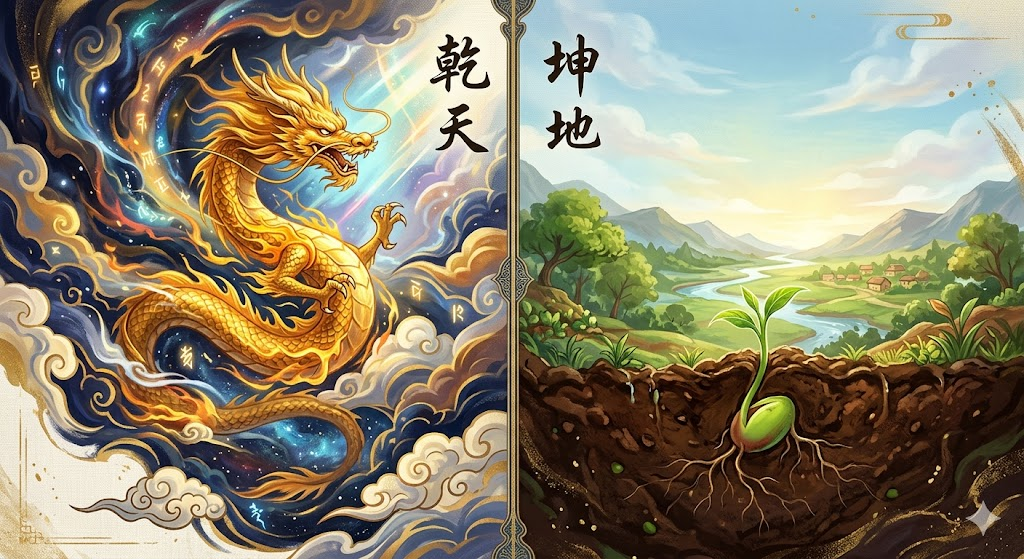
Hexagram 1: Qian (乾) – The Creative / Heaven
- Structure: Heaven over Heaven (All Yang lines)
- The Philosophy: Qian is pure, unyielding energy. It represents the creative power of the universe, initiative, and relentless forward momentum. The dragon is its symbol. It advises you to be strong, proactive, and persistent.
- Modern Example: You are launching a new startup or pitching a bold idea. Qian tells you the timing is right to take decisive action and lead with unwavering confidence.
Hexagram 2: Kun (坤) – The Receptive / Earth
- Structure: Earth over Earth (All Yin lines)
- The Philosophy: Kun is the perfect complement to Qian. It is the fertile soil that allows seeds to grow. It represents receptivity, devotion, patience, and yielding. True power here lies in supporting others and absorbing information rather than forcing your will.
- Modern Example: You are entering a new job in a completely unfamiliar industry. Kun advises you to keep your head down, listen, learn, and be a team player rather than trying to change the company culture on day one.
Hexagram 3: Chun (屯) – Difficulty at the Beginning
- Structure: Water over Thunder
- The Philosophy: Imagine a tiny sprout trying to push its way through hard, frozen soil. That is Chun. It signifies chaos and struggle at the start of a new endeavor. It is not a bad omen; rather, it’s a reminder that all profound growth requires initial friction. Seek out experienced helpers.
- Modern Example: Moving to a new country. The language barrier and cultural shocks are overwhelming right now. Chun reassures you that this initial chaos is natural. Find a mentor or a local guide to help you navigate the early days.
Hexagram 4: Meng (蒙) – Youthful Folly
- Structure: Mountain over Water
- The Philosophy: Meng represents a student standing at the foot of a foggy mountain—inexperienced but full of potential. It highlights the need for education and the right attitude toward learning. The oracle speaks only to those who ask with sincerity; if you ask the same question repeatedly out of doubt, it will ignore you.
- Modern Example: Making a mistake at work due to a lack of experience. Don’t hide it or act arrogant. Adopt a “beginner’s mind,” sincerely ask a senior colleague for guidance, and learn from the error.
Hexagram 5: Xu (需) – Waiting (Nourishment)
- Structure: Water over Heaven
- The Philosophy: Rain clouds are gathering in the sky, but the rain hasn’t fallen yet. You cannot force the storm. Xu advises patient waiting. However, this is not passive waiting; it is active preparation. Eat, drink, and gather your strength while you wait for the right moment.
- Modern Example: You have submitted a major project proposal or applied for a dream job and are waiting for the result. Do not panic or send desperate follow-up emails. Enjoy your weekend, recharge, and trust the process.
Hexagram 6: Song (讼) – Conflict
- Structure: Heaven over Water
- The Philosophy: Heaven rises upward, while Water flows downward. They are moving in opposite directions, causing fundamental disagreement. Song warns against stubbornness in conflicts. Even if you are in the right, pushing a dispute to the bitter end will cause collateral damage. Seek a neutral mediator.
- Modern Example: A bitter dispute with a business partner over shares. Song advises you to settle out of court. A compromise now is better than a prolonged legal battle that drains both your finances and mental energy.
Hexagram 7: Shi (师) – The Army
- Structure: Earth over Water
- The Philosophy: Water is hidden deep within the Earth. This hexagram represents organizing the masses and mobilizing resources for a serious cause. It requires strict discipline, a clear objective, and a wise, ethical leader. Without discipline, the “army” becomes a mob.
- Modern Example: Leading a cross-departmental corporate project with a tight deadline. You must assign clear roles, enforce strict deadlines, and communicate the ultimate goal clearly to keep the team from falling into chaos.
Hexagram 8: Bi (比) – Holding Together
- Structure: Water over Earth
- The Philosophy: Water rests on the earth, nourishing it while the earth holds the water. This is the hexagram of alliance, community, and mutual support. Success comes from gathering with like-minded people and aligning around a central, unifying figure.
- Modern Example: Building a community around a niche hobby or launching a community-driven website. Success won’t come from working in isolation. You need to network, partner with others, and foster a sense of belonging among your users.
Hexagram 9: Xiao Chu (小畜) – The Taming Power of the Small
- Structure: Wind over Heaven
- The Philosophy: Gentle wind blows high in the sky, gathering clouds, but it is not strong enough to bring rain just yet. You cannot make massive leaps right now. Progress is made through small, incremental refinements, gentle persuasion, and attention to minor details.
- Modern Example: Trying to improve your physical fitness. Don’t attempt to run a marathon tomorrow. Focus on small, daily habits—drinking more water, walking 20 minutes a day. Small accumulations will eventually lead to major transformations.
Hexagram 10: Lü (履) – Treading (Conduct)
- Structure: Heaven over Lake
- The Philosophy: The literal image is “treading on the tail of a tiger.” It sounds dangerous, but the tiger does not bite. Why? Because of proper conduct. Lü is about navigating highly sensitive situations or dealing with powerful people by using impeccable manners, respect, and emotional intelligence.
- Modern Example: Negotiating a raise with a notoriously difficult and strict boss. You can succeed, but you must approach the conversation with extreme professionalism, well-prepared data, and a respectful tone, ensuring you don’t trigger their ego.
End of Part 1. In Part 2, we will dive into Hexagrams 11 through 20, exploring the profound balance of Tai (Peace) and the stagnation of Pi (Standstill).
