

For over 2,500 years, Sun Tzu’s The Art of War has stood as the definitive treatise on military strategy. While chariots and bronze swords have been replaced by hypersonic missiles and artificial intelligence, the core philosophical tenets of this ancient Chinese masterpiece remain strikingly relevant. Among its thirteen chapters, Chapter 6, titled “Illusion and Reality” or “Empty and Full” (虚实 – Xu Shi), offers arguably the most profound insights into 21st-century global conflicts.
To understand modern military strategy—ranging from asymmetric warfare to cyber operations—one must first master Sun Tzu’s concept of the “Empty and Full.” This article explores how modern commanders and global superpowers utilize ancient Chinese wisdom to navigate the complexities of contemporary world warfare.
Understanding “Empty and Full” (Xu Shi)
In classical Chinese philosophy, Xu (虚) translates to empty, hollow, vulnerable, or deceptive. Shi (实) translates to full, solid, strong, or real. Sun Tzu posited that the essence of victory lies in the masterful manipulation of these two elements.
The fundamental principle of this chapter is concisely summarized in one of Sun Tzu’s most famous quotes: “An army may be likened to water, for just as flowing water avoids the heights and hastens to the lowlands, so an army avoids strength and strikes at weakness.” (避实击虚 – Bi Shi Ji Xu).

In a tactical sense, striking at the “full” means engaging the enemy where they are most heavily fortified, which leads to a war of attrition, heavy casualties, and Pyrrhic victories. Conversely, striking at the “empty” means identifying vulnerabilities—gaps in defense, logistical bottlenecks, or low morale—and concentrating your forces there. It is the strategy of maximum impact for minimum effort.
Asymmetric Warfare: The Modern “David vs. Goliath”
In modern world warfare, direct conventional confrontations between superpowers are rare. Instead, we witness asymmetric warfare, where non-state actors or smaller nations face technologically superior military giants. This dynamic is the ultimate manifestation of the Xu Shi principle.
A smaller force cannot survive by attacking the “Full”—the heavily armored tank battalions or aircraft carrier strike groups of a superpower. Instead, they target the “Empty.” By utilizing guerrilla tactics, utilizing complex terrain (like mountains or urban centers), and targeting supply lines, smaller forces exhaust their larger opponents.
A prime modern example is the ubiquitous use of inexpensive Unmanned Aerial Vehicles (UAVs) or drones. A $500 commercial drone modified with explosives can disable a multi-million-dollar main battle tank. The tank represents the slow, cumbersome “Full” (Shi), while the cheap, agile drone exploiting a blind spot represents the agile strike at the “Empty” (Xu). Modern commanders study Sun Tzu to realize that overwhelming firepower is useless if it cannot find a solid target to hit.
Cyber Warfare and Information Operations: The Ultimate Formlessness
Sun Tzu advised, “Be extremely subtle, even to the point of formlessness. Be extremely mysterious, even to the point of soundlessness. Thereby you can be the director of the opponent’s fate.” (微乎微乎,至于无形 – Wei Hu Wei Hu, Zhi Yu Wu Xing).

Today, the most dangerous battlefield has no physical form: Cyber Warfare. Cyber attacks bypass a nation’s “Full” defenses (its standing army, navy, and border walls) to strike directly at its “Empty” underbelly—civilian power grids, financial institutions, hospitals, and communication networks. A line of malicious code can cripple a nation without a single shot being fired, fulfilling Sun Tzu’s highest ideal: “The supreme art of war is to subdue the enemy without fighting.”
Furthermore, information operations and psychological warfare rely heavily on the illusion of Xu and Shi. Through social media manipulation, deepfakes, and coordinated misinformation campaigns, a state can project an illusion of overwhelming strength (Shi) to deter adversaries, or feign weakness and internal division (Xu) to draw an enemy into a trap. In the information age, controlling the perception of reality is just as critical as controlling physical territory.
Strategic Initiative: Forcing the Enemy’s Hand
Another critical component of Chapter 6 is the concept of strategic initiative. Sun Tzu wrote, “The clever combatant imposes his will on the enemy, but does not allow the enemy’s will to be imposed on him.” (致人而不致于人 – Zhi Ren Er Bu Zhi Yu Ren).
In contemporary geopolitical strategy, this is achieved by forcing adversaries to constantly react to your moves, thereby dispersing their forces. For example, by conducting sudden naval exercises, establishing new economic alliances, or launching satellites into contested orbital domains, a nation creates new pressure points. The enemy is forced to stretch their resources to cover these new potential threats, turning their previously “Full” defenses into “Empty” vulnerabilities through overextension.
When an adversary tries to defend everywhere, they are strong nowhere. Modern predictive Artificial Intelligence (AI) and Machine Learning (ML) systems are now being integrated into military command centers specifically to analyze vast amounts of global data to predict where an enemy is overextended (Empty) and where they are concentrated (Full).
Be Like Water: Fluidity in the 21st Century
Ultimately, Sun Tzu’s doctrine of “Empty and Full” is a call for extreme adaptability. He famously concluded that military tactics are like unto water; water shapes its course according to the nature of the ground over which it flows.
In the rigid trench warfare of World War I, armies forgot this principle, throwing “Full” against “Full” to disastrous results. Modern military doctrines—such as multi-domain operations which seamlessly integrate land, sea, air, space, and cyberspace—are designed to be entirely fluid. If an enemy blocks an advance on land (Shi), the modern military flows around them through a cyber-attack or a targeted economic sanction (Xu).
Conclusion
Sun Tzu’s Art of War is not merely a historical artifact; it is a living, breathing blueprint for modern strategic thought. The chapter of “Empty and Full” (Xu Shi) teaches us that strength is relative, vulnerabilities are always present, and deception is an integral part of survival.
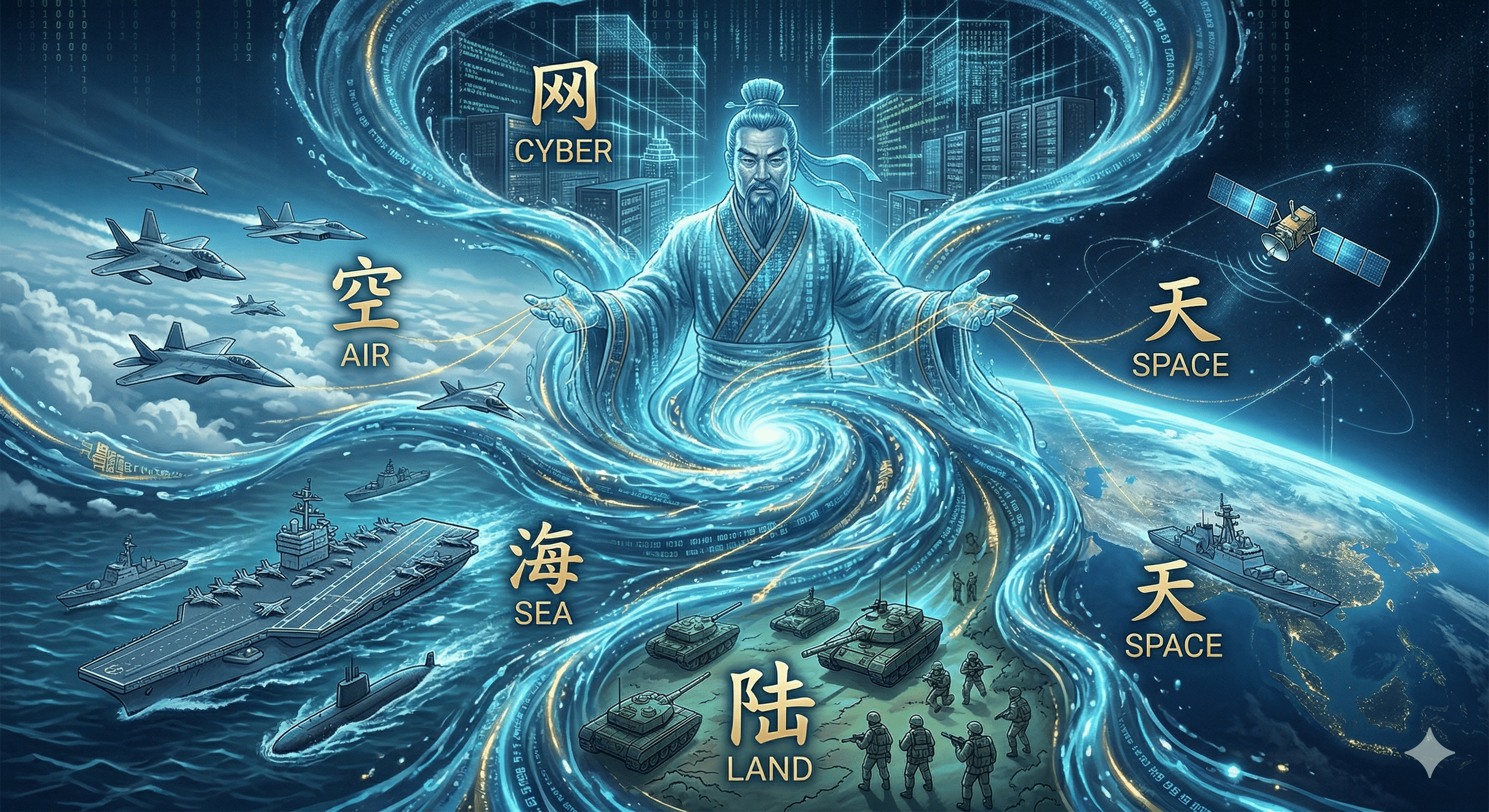
Whether it is a hacker probing a firewall for a weak line of code, a drone operator finding a gap in anti-aircraft defenses, or a diplomat creating a coalition to economically isolate a rival, the spirit of Sun Tzu commands the modern battlefield. To understand the future of global conflict, one must look back 2,500 years and master the delicate, deadly dance of the Empty and the Full.
