

If you’ve ever wondered if ancient China had its own version of Nostradamus, look no further than Tui Bei Tu—a cryptic, illustrated prophecy book that has baffled scholars, historians, and conspiracy theorists for over a thousand years. Known in English as Pushing Back the Diagrams, it’s not just a text; it’s a cultural legend, a puzzle, and a window into how the Chinese once imagined their future.
What Is Tui Bei Tu?
Legend says it was written in the early Tang Dynasty (627–649) by two imperial scholars: Li Chunfeng, a famed astronomer and mathematician, and Yuan Tiangang, a master of divination and physiognomy. Emperor Taizong commissioned them to predict the fate of the Tang Empire—and they didn’t stop there.

The book contains 60 numbered “images” (xiang), each paired with:
- A symbolic painting
- A cryptic four-line poem (chen, the prophecy)
- A longer explanatory ode (song)
The title comes from the final entry: “Ten thousand things can’t be fully told; better to push back and rest.” Hence Tui Bei Tu—“Pushing Back the Diagrams”.
How It Works: Symbols, Riddles, and History
Unlike Western prophecies that often use vague allegory, Tui Bei Tu weaves Chinese cosmology, the I Ching (Book of Changes), and historical allusion into every line. Each image is a visual riddle: a bird, a sword, a child, a broken palace, or a pair of figures. The poems use wordplay, homophones, and hidden characters to hint at events—dynastic rises and falls, wars, rebellions, and even technological shifts.
For example:
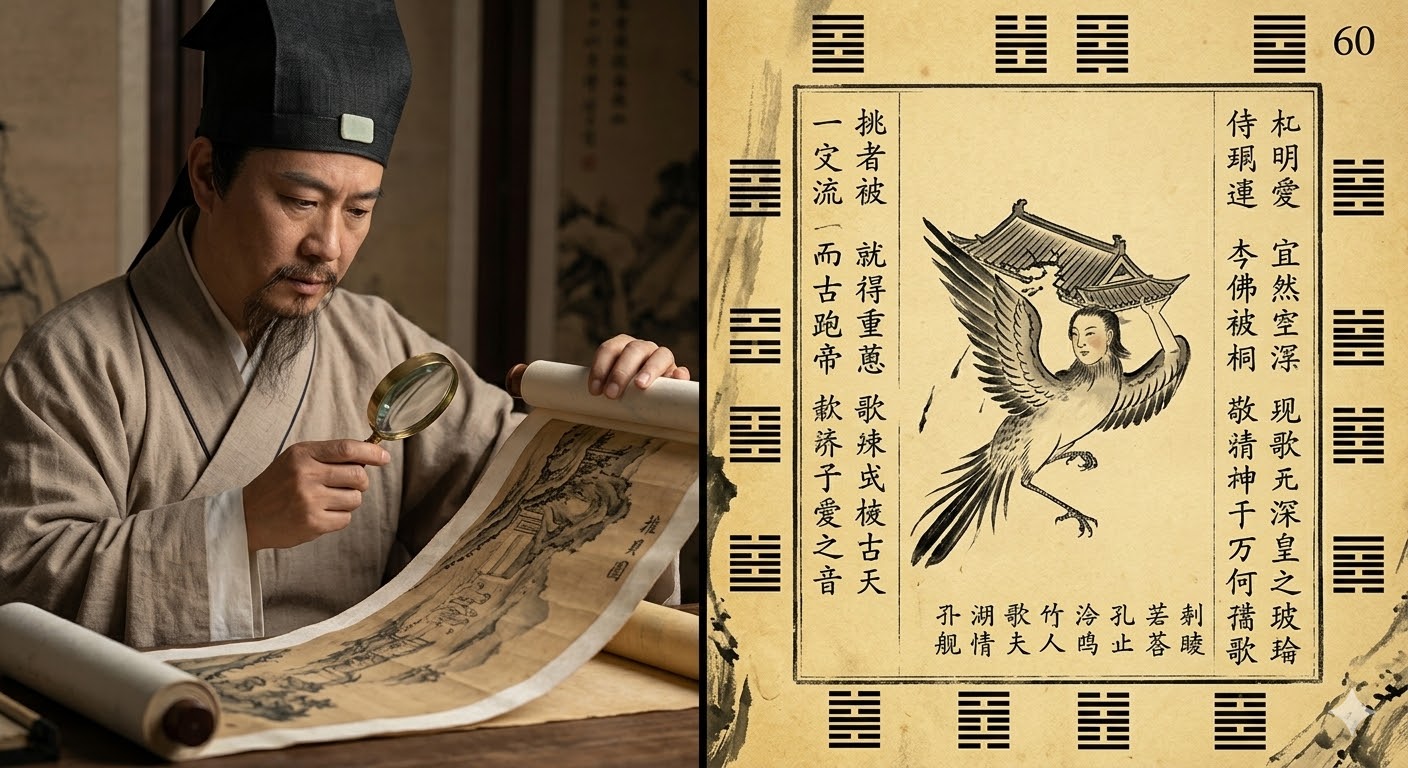
- One image of a woman holding a mirror and a sword is widely read as predicting Wu Zetian, China’s only female emperor.
- Later entries are said to foretell the fall of the Ming, the rise of the Qing, and even 20th-century upheavals.
Critics argue these are retroactive readings—people fitting history to vague verses. Believers counter that the book’s chronological structure (it unfolds in order from Tang onward) makes such coincidences hard to dismiss.
A Book Shaped by Centuries of Editing
Here’s the twist: no original Tang version exists. What we have today is a composite text, edited, rewritten, and added to by scholars, rebels, and rulers across dynasties.
The most famous modern edition—with annotations by the late-Ming scholar Jin Shengtan—was actually published in 1915, during the early Republic of China, under a pseudonym. Governments often banned Tui Bei Tu: it was seen as dangerous, because rebels could twist its verses to justify uprisings. So it survived in secret copies, hand-painted manuscripts, and underground circulation—adding to its mystique.
Why It Still Fascinates
Tui Bei Tu isn’t just about predicting the future. It’s a mirror of Chinese thought:
- It reflects the I Ching’s idea of yin-yang balance and cyclical history (rise and fall, unity and division).
- It shows how ancient Chinese linked heaven, earth, and human fate—a worldview still felt in culture today.
- And it taps into a universal curiosity: What’s next?
In the West, it’s little-known compared to Nostradamus. But in China, it remains a touchstone—discussed in books, online forums, and even pop culture. Some see it as a spiritual guide; others as a historical curiosity; still others as proof of ancient wisdom or even extraterrestrial influence.
The Final Riddle
The last of the 60 images shows two men pushing each other’s backs, with the verse:
“Ten thousand generations will pass; the way is clear. Heaven and earth return to unity; all under heaven is one family.”

It’s a vision of a peaceful, unified world—one that keeps readers wondering: Is this prophecy still unfolding?
Want to explore the actual prophecies? 👉 [Dive into our detailed breakdown of specific Tui Bei Tu hexagrams and their hidden meanings.]
Tui Bei Tu is more than a book. It’s a mystery wrapped in poetry, painted in ink, and whispered through centuries. Whether you take it as fact or fiction, it’s impossible to read without feeling the weight of time—and the human urge to see beyond the horizon.
