

In the vast landscape of Chinese political thought, few concepts have exerted a more enduring and subtle influence than wu-wei—often translated as “non-action” or “inaction.” Yet this term is frequently misunderstood, reduced to a passive retreat from governance or a rejection of responsibility. In reality,wu-wei, as espoused in the Tao Te Ching (the foundational text of Taoism), is a sophisticated political philosophy: it is not the absence of action, but action that aligns with the natural order (tao), unforced, unpretentious, and in harmony with the inherent rhythms of society. Throughout Chinese history, rulers and statesmen have invoked, adapted, and contested wu-wei, turning this philosophical ideal into a practical tool of governance—one that has shaped dynasties, calmed rebellions, and offered a counterbalance to the excesses of authoritarian control.
To grasp the political depth ofwu-wei, one must first discard the misconception that it advocates laziness or neglect. The Tao Te Ching teaches that “the greatest rulers are those whose existence is barely known to the people.” This is not a call for invisibility, but for a form of governance that does not impose artificial order on society, but rather nurtures the natural order that already exists. Just as a farmer does not force a seed to grow—instead tilling the soil, providing water, and allowing nature to take its course—the ruler who practices wu-wei does not impose rigid laws, excessive taxes, or arbitrary edicts. Instead, they remove obstacles, foster stability, and trust in the capacity of people to organize themselves. This is the essence of “governing by not governing”: the most effective rule is that which is felt least, because it works with, not against, the grain of human nature.
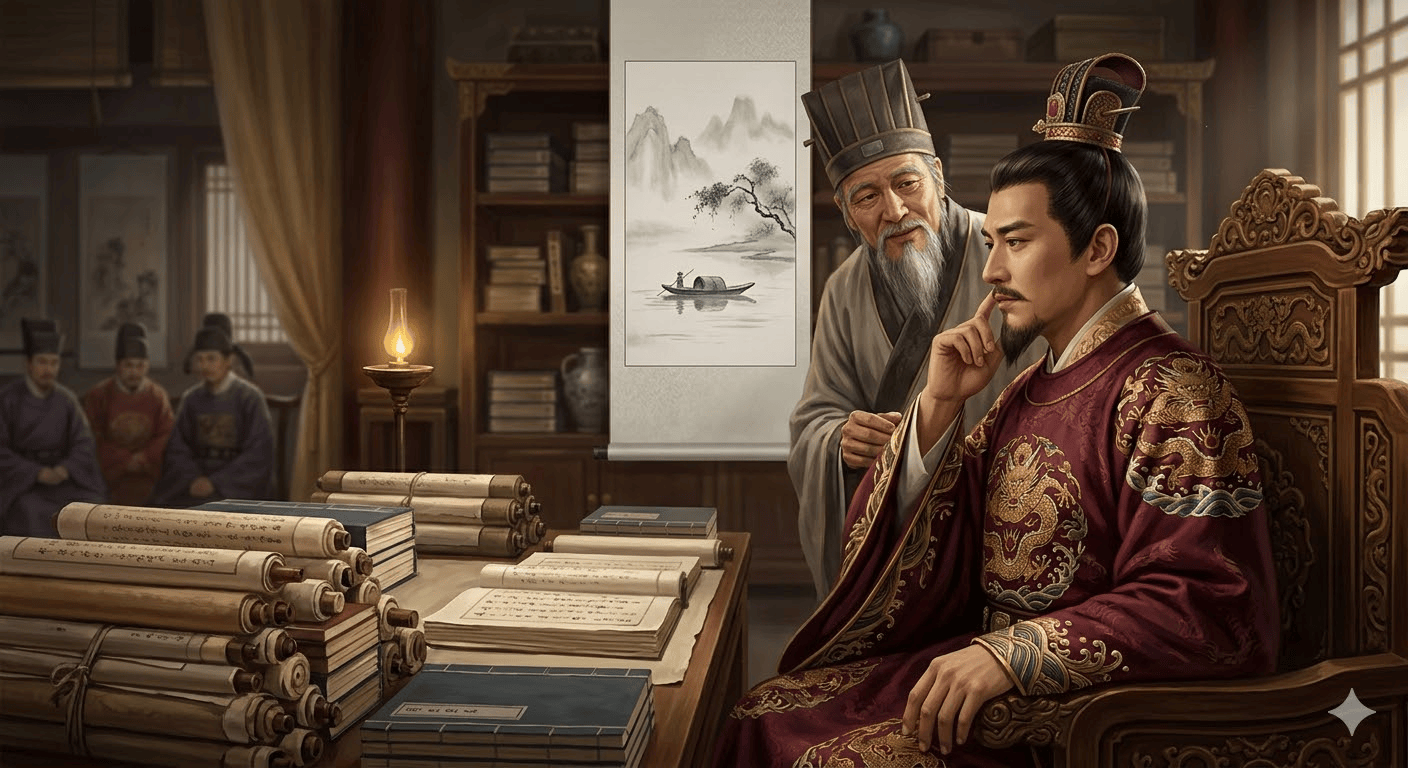
The first and most iconic embodiment of wu-wei in Chinese political history came in the early Han Dynasty (206 BCE–220 CE). After the chaos of the Qin Dynasty—a regime defined by harsh legalism, forced labor, and authoritarian control—the Han emperors, particularly Emperor Wen and Emperor Jing, turned to wu-wei as a strategy for recovery. The Qin had sought to control every aspect of society, from thought to labor, and in doing so, they exhausted the people and sowed the seeds of rebellion. The Han, by contrast, adopted a policy of huang-lao (a synthesis of Taoism and Legalism), which emphasized minimal government intervention, reduced taxes, and respect for local customs. They abolished harsh Qin laws, lifted restrictions on trade and agriculture, and allowed the economy to rebound naturally. The result was the “Rule of Wen and Jing,” a period of unprecedented peace and prosperity, where the people flourished not because of strict control, but because of its absence. This was wu-wei in action: the ruler stepped back, and society healed itself.
Yet wu-wei was never a static philosophy; it evolved alongside Chinese political history, adapting to the needs of different dynasties and the challenges of governance. During the Tang Dynasty (618–907 CE), often hailed as China’s golden age, wu-wei took on a new form. Emperors like Taizong, while maintaining a strong central government, embraced the Taoist ideal of balance. They surrounded themselves with wise advisors who urged restraint, avoided unnecessary wars, and invested in infrastructure that supported rather than controlled the people. Taizong once said, “A ruler is like a boat; the people are like water. Water can carry the boat, or it can capsize it.” This sentiment captures the core of wu-wei as a political philosophy: the ruler does not dominate the people, but serves as a steward of their well-being, recognizing that true power lies in harmony, not coercion. The Tang’s prosperity—its cultural flourishing, economic growth, and social stability—was a testament to the power of wu-wei to balance strength with restraint.
Critics of wu-wei often argue that it is a naive philosophy, unsuited to times of crisis or conflict. Yet history tells a different story. When rulers abandoned wu-wei and embraced excessive intervention—whether through harsh legalism, overtaxation, or imperial overreach—dynasties often fell. The late Qin, the late Han, and the late Ming all collapsed in part because their rulers ignored the Taoist ideal of balance, imposing their will on a society that could no longer bear it. By contrast, even in times of upheaval, rulers who turned to wu-wei as a guiding principle often managed to restore order. For example, after the An Lushan Rebellion (755–763 CE), which devastated the Tang Dynasty, Emperor Suzong and Emperor Daizong adopted policies of restraint: they reduced military spending, pardoned rebels who surrendered, and focused on rebuilding rural communities. This return to wu-wei did not erase the damage, but it prevented further collapse and laid the groundwork for a partial recovery.
The enduring relevance of wu-wei lies in its challenge to the modern assumption that effective governance requires constant intervention and control. In Chinese political thought, wu-wei is not a rejection of responsibility, but a recognition of its limits. It acknowledges that human society is a complex, organic system—one that cannot be micromanaged or forced into a rigid mold. Just as the tao flows naturally, so too does a healthy society, when given the space to do so. This is not to say that wu-wei is a panacea; it requires wisdom, restraint, and a deep understanding of the people’s needs. A ruler who practices wu-wei is not passive, but intentional—they choose when to act, when to step back, and when to trust in the natural order.
In the context of Chinese history, wu-wei has served as a counterweight to the excesses of power. It has reminded rulers that their authority is not absolute, but derived from their ability to align with the tao and the will of the people. It has also offered a vision of governance that prioritizes harmony over control, prosperity over power, and humility over arrogance. From the Han Dynasty’s recovery to the Tang’s golden age, wu-wei has proven that the most effective rule is often the most subtle—that sometimes, the best thing a ruler can do is to get out of the way.

Today, as we reflect on the role of governance in a complex world, the wisdom of wu-wei remains as relevant as ever. It challenges us to rethink the nature of power, to recognize the limits of intervention, and to embrace the value of balance. In Chinese political history, wu-wei is not just a philosophy—it is a practice, a reminder that true governance is not about dominating others, but about nurturing the natural order that binds us all. It is a lesson that has stood the test of time, and one that continues to offer profound insights into what it means to lead with wisdom and restraint.
If you want to consult the Oracle yourself, try our Free I Ching Tool on Yeetools
Does the Taoist concept of “Wu Wei” mean doing absolutely nothing?
Not at all. Wu Wei (无为) translates more accurately to “effortless action” or “non-forcing.” It means acting in perfect harmony with the natural flow of things, without forcing outcomes or acting out of ego. Think of it as sailing with the wind rather than exhaustingly rowing against the current.
How can I apply Wu Wei in a modern, busy lifestyle?
You can practice Wu Wei by letting go of the need to micromanage every detail of your life, accepting the things you cannot change, and acting only when the timing is naturally right. It’s about reducing mental friction and finding maximum efficiency with minimum stress.
